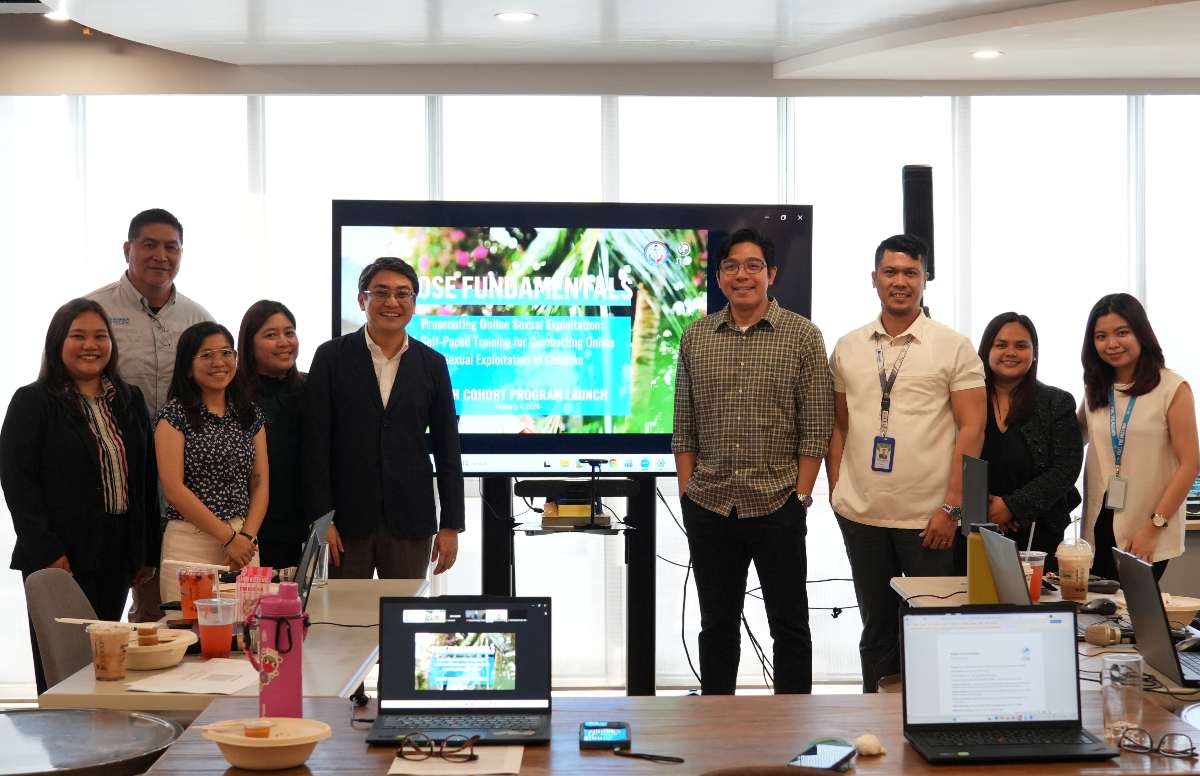
IJM Philippines’ first Virtual Safety Tech Roundtable, held on December 3, 2025, affirmed a central insight: “Prevention is the most impactful weapon against OSEC.”
Hosted by Technology and Financial Sector Engagement and Demand-Side Advocacy Teams, the roundtable discussion touched on SafeToNet's pilot implementation of HarmBlock on Human Mobile Devices (HMD), highlighting the tech sector’s role in strengthening online sexual abuse and exploitation (OSAEC) prevention efforts and how emerging detection technologies can support stronger laws.
The roundtable was attended by representatives from the technology and financial sectors, the National Coordination Center against Online Sexual Abuse or Exploitation of Children and Child Sexual Abuse or Exploitation Materials (NCC-OSAEC-CSAEM), Department of Justice Inter-Agency Council Against Trafficking (IACAT), the Office of Senator Risa Hontiveros, and the National Telecommunications Commission. Panelists included speakers from the Philippine Survivor Network, SafeToNet, and IJM Philippines, each offering perspectives on how cross-sector collaboration can drive meaningful impact.
Strengthening OSAEC Prevention Through Tech-Government Partnerships
The Virtual Safety Tech Roundtable centered on pioneering safety-by-design technology, bringing forward key insights from online safety leaders who demonstrated the latest privacy-preserving tools designed to prevent the creation and spread of CSAEM.
The Roundtable forms part of IJM’s ongoing collaboration with the tech sector to support the Philippine Government’s Strategic Plan Against OSAEC and CSAEM, particularly through solutions that enhance both prevention and protection.
Companies like SafeToNet and Thorn play a crucial role in shielding children from OSAEC. Prevention is a vital pillar in the broader child protection ecosystem—one where well-designed tools can enable the timely disruption of criminal activity, sparing children from experiencing planned abuse.
IJM works with industry partners to prevent, detect, and disrupt OSEC cases and related activity. As tech companies deepen collaboration with governments around the world, we move closer to a future where child- protective technology becomes a standard feature on every mobile phone, tablet, and laptop.
As tech companies deepen collaboration with governments around the world, we move closer to a future where child- protective technology becomes a standard feature on every mobile phone, tablet, and laptop.
Tech demo: How safety-by-design technology works
Companies such as Thorn and SafeToNet are eager to partner with governments and device manufacturers in mainstreaming privacy-preserving safety by design technology.
HarmBlock, developed by SafeToNet is an on-device AI tool that detects and blocks harmful content while protecting user privacy. Showcasing their pilot implementation with HMD, representatives from SafeToNet demonstrated how the HarmBlock system prevents users from saving or sharing sexual content and explained that because it is built into the operating system (OS), it cannot be removed or circumvented.
To enable full deployment of these tools, safety tech providers must work closely with device and equipment manufacturers so the technology can be integrated at the OS or hardware level.
Learn more about HarmBlock here.
Learn more about HMD smartphones with built-in HarmBlock technology here.
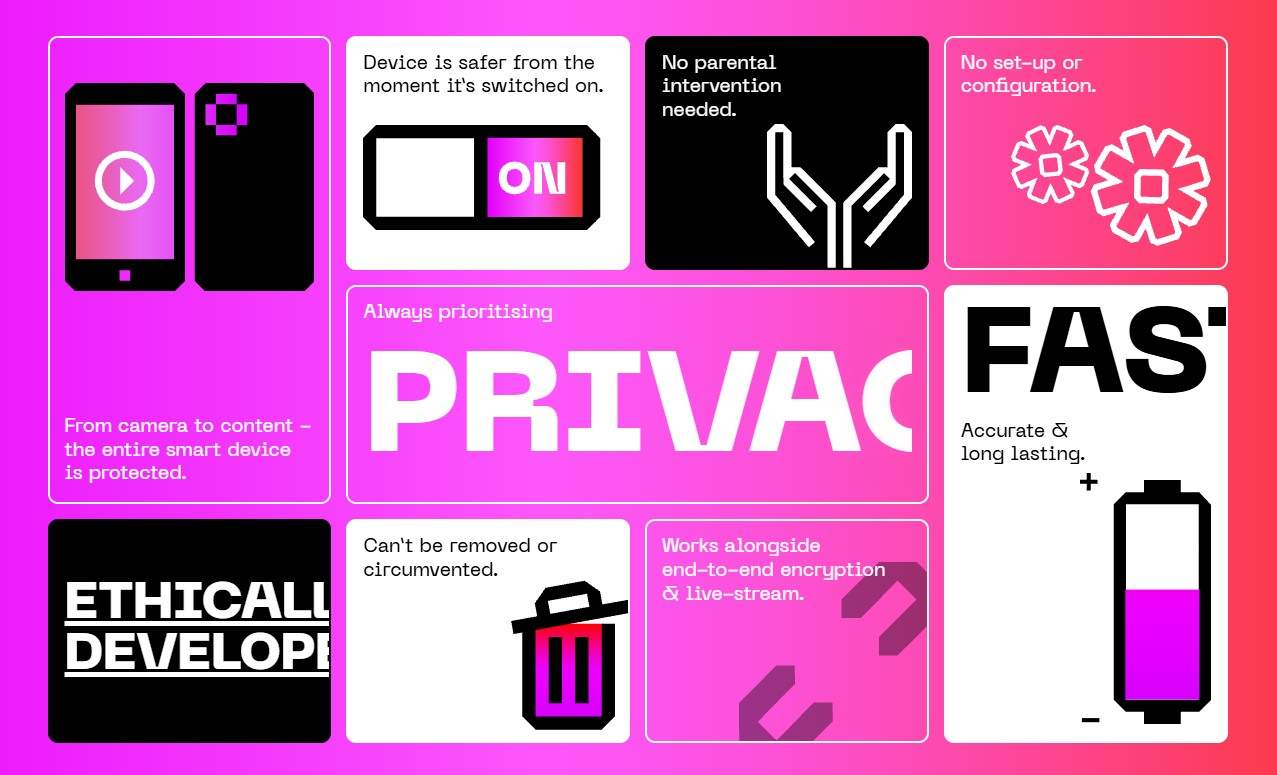 Some key features of HarmBlock featured on their homepage.
CSAM-blocking software preserves privacy
For years, the biggest barrier to adopting CSAEM-blocking tools has been the belief that such technology inevitably compromises privacy. Today, the assumption is shifting. Governments and major technology companies are increasingly recognizing that on-device solutions do not violate user privacy.
Both Meta and Apple publicly confirm this. Apple explains how its on-device safety features work:
How Communication Safety protects your child's privacy
Communication Safety uses on-device machine learning to analyze photo and video attachments and determine if a photo or video appears to contain nudity. Because the photos and videos are analyzed on your child's device, Apple doesn't receive an indication that nudity was detected and doesn't get access to the photos or videos.
Source: https://support.apple.com/en-ph/105069
Similarly, Meta notes that its nudity-protection features function entirely on the user’s device: “the images are analyzed on the device itself, nudity protection will work in end-to-end encrypted chats” and that “Meta won’t have access to these images – unless someone chooses to report them to us”
Source: https://www.reuters.com/technology/meta-blur-instagram-messages-containing-nudity-latest-move-teen-safety-2024-04-11/
The next frontier: legislation
The Roundtable underscored that technology has advanced far enough for legislation to move forward confidently, without concerns about technological readiness or reliability.
Panelists stressed the urgency:
“Legislation is needed. The content is illegal,” John Tanagho emphasized.
John Tanagho is Director of Demand-Side Advocacy, IJM Philippines, and Executive Director of IJM’s Center to End Online Sexual Exploitation of Children, highlighted the progress in the European Union. He cited MEP Caterina Chinnici (EPP), Co-Chair of the Child Rights Intergroup, European Parliament, who stated in late 2025:
"I have also recently returned from a mission to the Philippines, where over 500,000 children are exploited for the live-streaming of child sexual abuse. This legislation marks an important milestone and sends a desperately needed message of hope to millions of children around the world, as it aims to curb the demand for this form of exploitation by criminalising live-streamed child sexual abuse across our Union. We now need to pass the Regulation to ensure that children are protected - not only after abuse has occurred, but before it happens, in every corner of the digital world."
Tanagho also shared Lord Nash's speech to the House of Lords on his proposed CSAEM Amendment, November 2025:
"My amendment 271-A, if passed, would have the effect of using software to screen out all child sexual abuse material, including livestreaming on smartphones and tablets and, in due course, on all devices."
"It would also apply to private communications, which is where the majority of livestream child sexual abuse takes place and which is not covered by the Online Safety Act."
"[ ... ] Historically, it has been difficult to screen this stuff out because it happens in real-time and will often be taken down quickly. However, now Al-powered direction technology offers a breakthrough. This technology can be embedded directly into the operating system of internet-connected, camera-enabled smart devices. It identifies and disrupts child sexual abuse material in real-time, preventing it from being captured or viewed. And because detection happens entirely on the device, it preserves user privacy and is fully compatible with end-to-end encryption."
"The UK Government should therefore now legislate to require device manufacturers and operating system services to incorporate safeguards which disrupt child sexual abuse material, including livestreaming, into the operating systems of devices sold in the UK putting a stop to the abuse before it starts."
The filing of Senate Bill 1588 proposing Safety-by-Design amendments to RA11930
On December 9, a few days following the Roundtable, Senate Bill No. 1588 was filed. This bill proposes an amendment to the Anti-OSAEC Law (RA 11930) and introduces explicit safety-by-design requirements across online services, intermediaries, technology platforms, and offline tools. These provisions ensure that platforms and technologies are proactively designed to prevent, detect, and disrupt OSAEC/CSAEM, not merely react after harm occurs.
View the bill here
Watch the January 21 senate hearing covering Senate Bill 1588 here:
RA 11930 was passed in 2022 and since then much has evolved in the crime, including AI-related threats. Much has also evolved in technology and as the roundtable shows, detection technology is ready to ship. The bill places additional requirements on technology providers and platforms to ensure that safety features are built into their products:
It mandates:
- Built in technical barriers against generating sexualized child content.
- AI model safety layers and dataset hygiene
- Default safety settings
- Rapid-response pipelines for blocking and reporting
- Privacy conscious design
- Governance level responsibility
- Safety features in both online and offline technologies
The proposed amendments move beyond the current mandate of “take it down when you find it,” toward proactive prevention as the “high-impact weapon against OSAEC.”
Proactive prevention in the financial sector
Atty. Lawrence Aritao, Director of Tech and Financial Sector Engagement at IJM Philippines, recommended that Philippine payment providers and cryptocurrency platforms appoint a Child Safety Officer to strengthen coordination with law enforcement and tech companies.
He also called for a shift in the anti-money laundering framework (AMLF) to shift from a posture of reacting to transactions that have slipped through the system, to proactive prevention. This means viewing the AMLF as the guardian at the gate, keeping a watchful eye over both good and bad transactions with child protection in mind. With every suspicious payment flagged, every illegal, OSEC-related transaction blocked, you are preventing a crime from even happening in the first place.
With every suspicious payment flagged, every illegal, OSEC-related transaction blocked, you are preventing a crime from even happening in the first place.
This makes a difference. Disrupting at the right time spares a child from the unthinkable.
Atty. Aritao also emphasized the need for clear guidance from the Banko Sentral ng Pilipinas enabling financial institutions to share critical information with law enforcement. He also urged foreign tech companies operating in the Philippines to recognize that doing the bare minimum is not sustainable—and that investing in child-safety measures now is far less costly than the long-term consequences of failing to act.
Disrupting OSAEC
Moderator Katia Joo highlighted a central challenge:
“In the Philippines, there is higher awareness of the crime. But most of the world still do not know that OSEC exists and that it is happening.”
Tanagho echoed that many tech companies are still falling short. While progress is slow, he relentlessly believes that the goal is achievable: all tech devices safe out of the box.
Atty. Noel Eballe, Director of National Advocacy, IJM Philippines, brought the roundtable to a close:
“Our conversation this afternoon highlighted two critical needs,” Atty. Eballe said. "The importance of collaboration, that no single organization or platform can solve this alone...and the second thing is the importance of innovation with responsibility.”
Child protective technology must be two steps ahead with “safety features that evolve as fast as the threats.”
And that "technology, which has created new avenues for harm, especially for our children, can also be one of our greatest tools in protecting them.”
If you are a tech or financial company and would like to collaborate with IJM on safety-by-design or are interested to learn more, please contact [email protected]